


Hot Mat Pilates Marbella: Infrared vs Reformer Explained
Updated: Aug 13
Infrared Hot Mat Workout in Marbella: What It Actually Is, and Whether It's Worth It
It's been 15 years since my first reformer Pilates class, and in all that time I've never once done a class in a heated room. So when GROUND opened in San Pedro, I did what I always do, which is get slightly suspicious and start reading. Here's what I found out before booking, because I suspect if you're reading this you've got the same questions I did.
What Is a Hot Mat Workout?
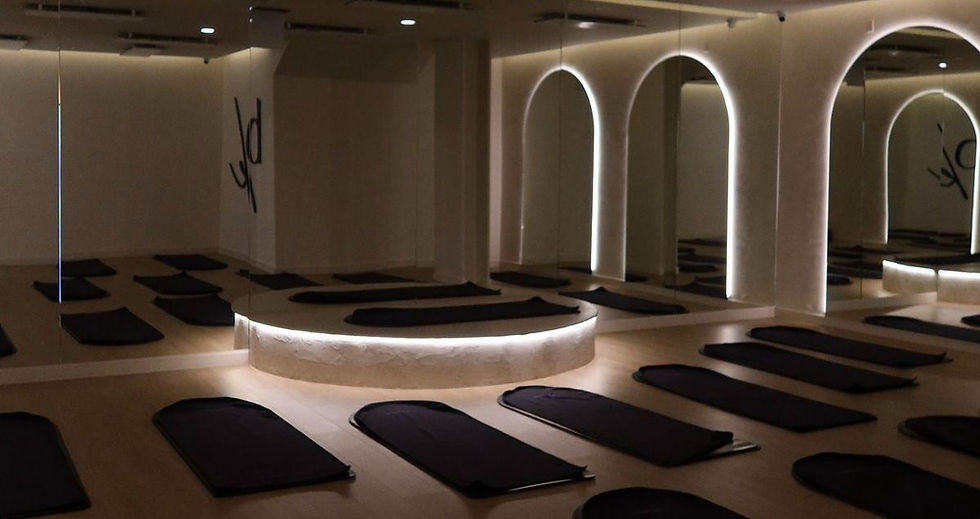
Hot mat is a mat-based workout performed in a heated studio, using your own body weight and small equipment rather than a reformer machine. The heat is there to warm the muscles faster, which increases how far you can move into a stretch and how much you sweat.
That's the short version. The longer version is that it's a genuinely different kind of session to reformer. On the reformer, the springs do the governing. You're held in position, the resistance is precise, and the whole thing is about control. On the mat in a hot room, there's nothing holding you. It's all you, and the heat is doing something to your muscles that changes what your body will let you do.
I'll be honest: my first reaction was that heat sounds like a gimmick (I've seen enough fitness trends come and go to be a bit cynical about anything with a marketing name). But infrared is not quite the same as the sweaty hot room you're picturing, and that's the bit worth understanding.
Key takeaway: Hot mat workouts are bodyweight sessions in a heated room. No machine, no springs, nothing to hide behind.

What's the Difference Between Infrared and a Traditional Hot Room?
Traditional hot studios heat the air, usually to somewhere around 35 to 40°C, using air conditioning systems or space heaters.
Infrared studios use panels that emit radiant heat, which warms your body directly rather than warming the air, so they typically run cooler, around 30 to 35°C, while still making you sweat. This is the bit that changed my mind.
In a traditional hot room, the air itself is the hot thing, which is why those rooms get heavy and humid and why some people find them genuinely unpleasant to breathe in. Infrared panels skip the air. The warmth lands on you, so you get deep muscle heat at a lower ambient temperature and the room stays more breathable.
GROUND, which is Studio 34's hot mat studio in San Pedro, is infrared heated. So if you've tried a hot class before and hated the stuffiness, it's worth knowing that it's not the same experience. And if you've never done heat at all, infrared is the gentler door in.
Key takeaway: Infrared heats you, not the room. Lower air temperature, same sweat, far less of that heavy, stuffy feeling.

Hot Mat or Reformer: Which Should You Actually Book?
Book reformer if you want precision, controlled strength and support for an injury. Book hot mat if you want conditioning, mobility and intensity. Most people who stick with training long term end up doing both, because they train different things.
After 15 years, I've got a bias here and I'll own it. Reformer is what fixed my back.
The springs mean the load is adjustable to the millimetre, an instructor can dial it up or down for your body on the day, and if you've got something going on with your spine or your knees, that's the safer, more precise option.
But precision isn't everything. Reformer can become a bit of a comfort zone, and I say that as someone who has absolutely been in it. Mat work in a heated room takes away the machine and shows you fairly quickly which bits of your own strength you've been letting the springs cover for. Which is humbling, and probably good for me.
The honest answer is that they're complementary rather than competing.
Reformer builds the control, hot mat tests whether you actually own it.
Key takeaway: Reformer for precision and rehab. Hot mat for conditioning and mobility. Do both if you can.

What Are SCULPT, SHRED, TRX and STRETCH?
GROUND runs four class formats, and SCULPT is the hot mat class. It's strength-focused mat work in the infrared room, and it's the session everything above is describing. The other three are their own thing: SHRED is the higher-intensity conditioning class, TRX adds suspension straps for upper-body and core work, and STRETCH is the mobility and recovery session.
If you're new, SCULPT or STRETCH is where I'd start, rather than throwing yourself at SHRED on day one, which is exactly the sort of thing I would have done at 30 and would not do now. The heat alone is an adjustment. Give yourself a class or two to find out how your body responds to it before you go looking for the hardest thing on the timetable.
STRETCH in an infrared room is also, I suspect, the class most people underestimate and then quietly become obsessed with. Heat and mobility work together properly.
Key takeaway: SCULPT is the hot mat class. Start there or with STRETCH. SHRED will still be there next week.
Is Hot Mat Safe, and Who Should Avoid It?
Heated exercise is safe for most healthy adults, but it puts more demand on your cardiovascular system and you dehydrate faster than in an unheated class. If you're pregnant, have a heart condition or low blood pressure, or you're on medication that affects how you regulate temperature, speak to your doctor before booking and tell the studio when you arrive.
Practical things that actually matter. Drink water through the day beforehand, not just in the ten minutes before class. Bring more water than you think you need. If you feel dizzy or your head goes swimmy, sit down and stop. Don't be brave about it, nobody in that room cares, and the instructor would much rather you sat out for two minutes.
And tell them about your injuries before class, not after. A studio that doesn't ask you about injuries is a studio that's not paying attention, and that's true whether the room is heated or not.
Key takeaway: Hydrate before, not during. Tell them about injuries. Sit down if you feel off.
Where Can You Do Infrared Hot Mat in Marbella?
GROUND by Studio 34 in San Pedro de Alcántara is currently the infrared hot mat option in the Marbella area, and it's in the same building as Studio 34's reformer studio, so you can do both on one membership.
That's the part I think is genuinely useful rather than just clever marketing. Most people end up either paying for two memberships at two places, or picking one and missing the other. Being able to do reformer on Tuesday and hot mat on Thursday without joining two studios is a real thing when you're fitting training around school runs.
Prices at the time of writing: drop-in €22, five classes €95, ten classes €175, unlimited hot mat €185 a month, and HYBRID memberships combining reformer and GROUND from €169. There's a two-week unlimited taster at €75, which is what I'd do.
Key takeaway: GROUND, San Pedro de Alcántara, minutes from Puerto Banús. Reformer and hot mat under one roof.
What I´d Do Next
Take the two-week taster over a single drop-in. One class in a heated room tells you almost nothing except that you got hot. Two weeks tells you whether your body actually likes it, and that's the only question that matters.
I'm booking mine. I'll write about it properly once I've done a few and can tell you whether 15 years of reformer prepared me for it or not (I suspect not, and I suspect I'll be sore).
To book your class today by visiting https://www.studio34reformer.com/ground-marbella-book

Comments